I was talking about this with a client today and I think it’s worth sharing it. When you use your AI harness (GitHub Copilot CLI in the example below, it could be Claude Code, Codex, etc.) you can easily miss all the things it does for you and why it’s a big step forward.
If you think about it, the first significant change developers realise is when they move away from chatting to an AI assistant to using agents. It is really evident, there is a significant speed multiplier at play.
The second change is more subtle yet carries a lot of impact: when you leverage a harness, it’s not just agents coordination and orchestration. Speed is not the only factor. It drives an end-to-end logical process without significant steering, and actually does a lot more than you think…
Look at this:
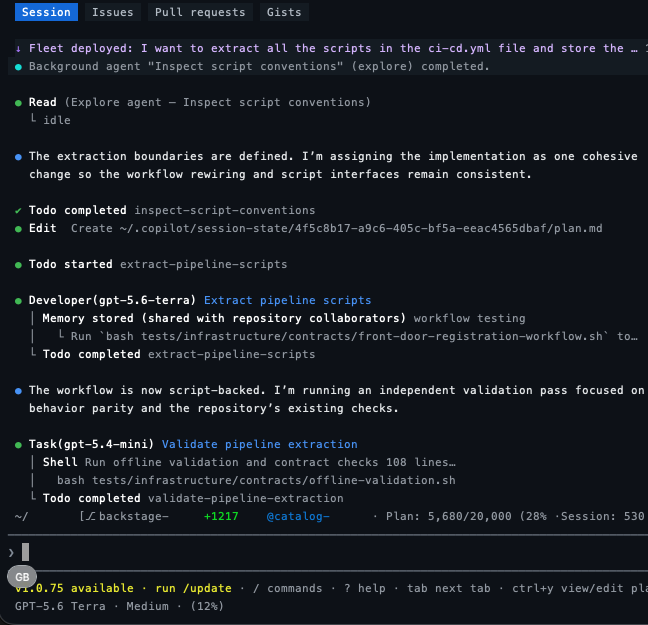
Besides using a fleet of agents to parallelise something I would need later on, there are more steps in there than just executing what I asked for with an agent, and this is why unattended delegation is so powerful.
There are checks in place, validations to perform, temporary intermediate transformations you don’t see, etc. The harness performs them as agentic tasks regardless, choosing what it believes is the most appropriate model (gpt-5.4-mini here rather than the gpt-5.6-terra model I am using for the bulk of the work) to keep costs down.
This is the true power of your harness, which also explains what you get when you start adding Spec-driven Development on top of it.